1000 KDP Publishing Prompts: Your Self-Publishing Blueprint
Starting or scaling a low-content book business on Amazon KDP brings many decisions. You need ideas that resonate with buyers, a cover that stops the scroll, and copy that converts lookers into readers. Without a clear process, these steps can feel like guesswork. That is where a structured set of prompts can shift your approach from reactive to intentional.
What you are looking at is a resource designed to give you that structure. It aims to replace the scattered notes and half-formed ideas with a repeatable system. Whether you have published two books or two hundred, the promise of a comprehensive toolkit that covers idea generation, design, marketing, and automation is worth examining closely.
Shifting from Random Action to Strategic Publishing
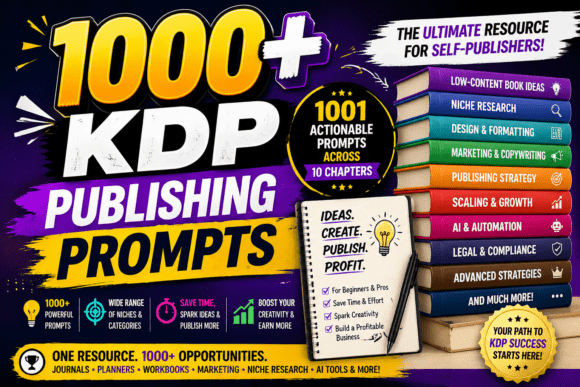
Many self-publishers fall into a pattern of starting a book, formatting it as quickly as possible, and moving on. This approach often leads to inconsistent quality and mediocre results. The 1000 KDP Publishing Prompts collection addresses this by organizing the entire publishing workflow into thirteen logical chapters. Each prompt is a focused question or instruction that forces you to think critically about a specific element of your book.
For instance, instead of vaguely wondering what kind of journal to create, you might encounter a prompt that asks you to identify a specific pain point for a target audience and design a solution around it. This level of specificity turns a fuzzy idea into a concrete product spec. The true value lies in the cumulative effect: using hundreds of these prompts across your projects gradually builds a mental framework for making better publishing decisions faster.
Finding Profitable Niches Without Endless Scrolling
Niche research often feels like searching for a needle in a haystack. You look at categories, read reviews, and try to guess what will sell. The prompts in this toolkit are designed to change that. They guide you to look at market data from angles you might have ignored. You are not just told to find a niche; you are prompted to examine customer reviews for unmet needs, to analyze competitor titles for gaps in formatting, and to identify keywords that signal actual purchase intent.
This shifts the focus from copying what works to understanding why it works. For a small business owner or freelancer looking to add a passive income stream, this structured approach saves significant time. Instead of spending weeks on research, you can work through targeted prompts that surface actionable opportunities in a fraction of the time. The result is a niche selection backed by reasoning, not just instinct.
Design and Formatting Prompts for Professional Results
Book interiors and covers can make or break your sales. A poorly formatted interior leads to returns and negative reviews. A cover that does not communicate value at thumbnail size gets ignored. The design and formatting prompts within this collection help you avoid these pitfalls by walking you through the critical decisions beforehand.
You will find prompts that help you choose the right trim size, set up margins for bleed, and select fonts that fit your genre. There are prompts for interior layouts of specific products like planners, gratitude journals, and logbooks. These are not abstract design lessons; they are direct instructions that you can apply immediately in your software of choice. The practical benefit is clear: you reduce trial and error, avoid costly formatting mistakes, and produce books that look professional on page one.
AI Automation Prompts Streamline Your Workflow
Speed is an advantage in KDP publishing, but quality often suffers when you rush. Automation, especially through AI tools, can help you maintain quality while increasing output. The AI automation prompts included in this toolkit are particularly valuable for creating content variations, drafting book descriptions, and even brainstorming new product angles.
Instead of staring at a blank screen, you can feed these prompts into your preferred AI assistant and receive structured outputs that you can refine. This is not about producing generic content; it is about using the prompt as a framework to generate ideas that you then customize. For a blogger or content creator who is already comfortable with AI, this section alone can cut the time spent on repetitive tasks by more than half. The prompts act as a bridge between raw AI capability and your specific publishing goals.
High-Converting Book Descriptions and Sales Copy
A great cover gets the click, but the book description gets the sale. Writing copy that converts is a skill that requires practice and a clear understanding of your audience. The chapter on book descriptions and sales copy is one of the most practical sections of the 1000 KDP Publishing Prompts collection.
These prompts push you to define your target reader, articulate the main benefit of your book, and address the hidden objections that prevent a purchase. You will create multiple versions of bullet points, hooks, and calls to action. Over time, your copy improves not because you memorized formulas, but because you practiced the thinking behind them. For entrepreneurs and marketers who already understand conversion, these prompts offer a structured way to apply existing skills directly to Amazon listings.
Who Benefits Most from This Toolkit
The design of this resource suggests it is built for a wide range of users, but certain groups will find it especially valuable. Beginners who feel overwhelmed by the many steps of publishing will benefit from the step-by-step guidance that turns a complex process into a manageable checklist. Experienced publishers who have hit a plateau will find prompts that challenge their assumptions and push them toward higher-quality products.
Additionally, freelancers and educators who use books as teaching tools or lead magnets can leverage the content creation prompts to build workbooks and guides quickly. The scalability section is particularly relevant for small business owners who want to expand their product line without hiring extra help. That said, someone who prefers entirely original content with extensive custom writing may find the prompt-based approach to be a starting point that still requires significant adaptation. It is a tool for structured thinking, not a replacement for original effort.
Realistic Use Cases and Practical Application
Consider a scenario where you want to publish a habit tracker for busy professionals. Using the prompts, you could begin by researching popular habit tracking formats, identifying the specific pain points professionals mention in reviews, and then designing a layout that addresses those gaps. The prompts guide you through creating a cover that signals utility, writing a description that speaks directly to a tired office worker, and setting up the interior for easy printing.
Another use case involves scaling from ten low-content books to fifty. The growth strategy prompts ask you to analyze your current bestsellers, identify patterns in their performance, and create new products that follow those patterns. This is far more efficient than randomly guessing which niche will work next. The prompts provide a decision-making framework that reduces risk and increases the likelihood of consistent results.
Considerations Before You Start
No toolkit is a magic bullet. The value you get from 1000 KDP Publishing Prompts depends entirely on how consistently you apply the prompts. If you work through them once and never revisit them, the long-term benefit will be limited. The real power comes from using the prompts as a recurring checklist for every new book project.
Furthermore, the prompts are guides, not templates. You will still need to make your own design choices, write your own copy, and evaluate your own market research. For those who prefer complete creative freedom without a structured process, the sheer volume of prompts might feel restrictive rather than empowering. Comparing this resource against other publishing guides or courses is wise if you are unsure whether a prompt-based format suits your workflow.
Building a Sustainable Publishing Practice
The ultimate goal of any publishing toolkit should be to help you build a practice that lasts. You want books that sell consistently, a process that does not burn you out, and a skill set that grows with each project. The 1000 KDP Publishing Prompts resource is built to support exactly that outcome. It encourages deliberate practice by breaking down the publishing process into small, repeatable actions that build competence over time.
For adults aged twenty to fifty who balance publishing with other professional or creative pursuits, this kind of structured support can make the difference between a hobby that fizzles and a business that grows. It gives you a framework to return to when you feel stuck and a set of questions to ask when you are unsure of your next step. In a competitive marketplace, having a reliable process is as valuable as having a great idea.